Sunday, May 8, 2011

Appleby Cemetery, Burlington

Gates of Appleby Cemetery. Est 1861
South Post of Gate is a dedication to the Pioneers buried here


Grave of George Williams
Founder of the Doherty Men's Fraternity

Ornamental Iron Planter
Williams Plot


Appleby Cemetery is located on the west side of Appleby Line, south of Dundas Street in the City of Burlington.  The stone plaque on the north gate post states that the cemetery was established in 1861, but there are markers that bear dates in the early 1850's  The earliest burial is supposedly for Benjamin Matthewman in 1847.  Although there is a family plot for Matthewman, there in no reference to the burial of Benjamin in that year.

The land for the cemetery and church was obtained from David Alton, in 1847. A brick church was dedicated at this location which replaced the framed church next to Mount Vernon Cemetery that had served the Wesleyan Methodists of the area.  The Appleby Church was torn down in 1906. In 1905 the cemetery was managed by the Appleby Cemetery Board, in 1983 this was turned over to the City of Burlington who manage this site today.

Bronte Cemetery, (Bronte Village) Oakville


Bronte Cemetery est. 1823.


Bronte Cemetery is probably one of the oldest cemeteries in Trafalgar Twp, it is located on the south-west extremity of Bronte Village, Oakville near Lake Ontario and the end of West Street.  The first burial to take place was that of Hannah S. Haviland, aged 4 who died in 1823.

Grave of Settler John Ribble
Notice the inverted 'N"
Old Headstones Against a Tree


Headstone of Hannah S. Haviland
1st Burial at Bronte Cemetery 1823


One of the earliest settlers to arrive in Bronte Village (or the mouth of Twelve) was Philip Sovereign and his family in 1814 from Sussex County, New York.  Their farm extended along the lake front west of the Indian Reserve on old Lake Road.  Philip died on July 2, 1833 and is buried in this cemetery along with his son Charles who farmed the land until his death in 1855.  Their graves are located on the west side of the property, neither of their headstones are standing, both are lying flat and are slowly sinking into the ground. 

Another early settler was John Belyea who was a United Empire Loyalist of Dutch or Palatine German decent from Philipsburg, Westchester County, New York.  John Belyea died on April 14, 1825 and he is buried in Bronte Cemetery along with his young son Benjamin.  Their graves to can be found at the north end of the cemetery.  

The last burial took place in 2009 in a family plot which over looks beautiful Lake Ontario. Today the cemetery is in the care of the City of Oakville.


Saturday, April 30, 2011

Derry West Anglican Cemetery, Mississauga

The Founding of Derry West

Submerged Headstone


Sunken Headstones

Derry West Anglican Cemetery is located on the N/W corner of Derry Road and Hurontario Street in the City of Mississauga. It was the site of the original Hurontario Anglican Church, established in 1822.  Joseph Carter received a crown grant for 200 acres.  On this concession he built a small log church which opened on July 27th, 1829.  The corner stone was blessed with whiskey brought from the hotel located across the road.  Bishop Strachan refused to grant holy orders for the church stating that it had begun in drunkenness and ribaldry.  After, a disappointed Carter sold the farm to William Orr, but the 1/2 acre on which the church sat was deeded to the Church of England.  In 1843 the rough cast church was replaced with a mud brick building

Derry West was named by George Graham who's forefathers fought at Londonderry Ireland.  In 1867 the small hamlet was swept by fire, from which it never really recovered. There is no trace of the earlier burials from 1829 to 1840.  The earliest maker is that of Ann Nixon 1842, which is towards the rear of the property and is laying flat in the ground.  The last burial is that of Mary Graham in 1936.  The cemetery is under the care of the City of Mississauga.  

Friday, April 29, 2011

Bolton Anglican & Methodist Cemeteries, Bolton

Hall Monument in Old Anglican Cemetery

Base of Monument in Family Plot


Bolton Anglican Cemetery is located on a hill opposite Laurelhill Cemetery on Centennial Drive, west side of Hwy 50.  The Cemetery and first Anglican Church in Bolton Village was established on land conveyed by James and Ellen Bolton and Samuel and Ann Sterne in 1845.  However, burials on the land were as early as 1822.  The decorative iron fences found around the plots were made by Plummer Foundry in Bolton. The last burial was that of John Lougheed 76 years, on April 14, 1925.

Cairn Erected in 1972 the year of Bolton's Centennial

 At the center of the grounds is a walled cairn erected in 1972 the year of Bolton's Centennial. Headstones from both cemeteries that were found laying on the ground were preserved in this cairn.  The cairn sits on the old railway leading to the old Anglican Church site.

Old Methodist Cemetery


The Methodist Cemetery is located on the north hill of the property, opposite the Anglican Cemetery.  The land was conveyed by James and Ellen Bolton and James and Maria Warbrick to the trustees of the Wesleyan Methodist Church in Bolton Village circa 1850.  After 1893 there were few burials in either cemetery due to the establishment of the Laurelhill Cemetery.  A number of burials from both cemeteries were  also relocated to the new cemetery in the late 1800's early 1900's

All Saints Anglican Cemetery, King City

Old Headstones at All Saints 

Grave for Hall Contains 5 burials, 4 are children


All Saints Anglican Church and Cemetery est 1857 is located on the west side of Keele Street, just south of King Street in King City.  The Church is still an active congregation, but the cemetery is inactive, receiving its last burial in 1926.  The cemetery does take cremation memorials in the form of newly planted trees with memorial plaques mounted on wooden pedestals.  A large number of headstones are either not legible or have sunken into the ground. The cemetery is on the south side of the church building.

Sunday, April 24, 2011

Schomberg Union Cemetery, Schomberg Twp. of King.

Chapel at Schomberg Union Cemetery

Quaker Pioneer Graves

Quaker Pioneer Graves

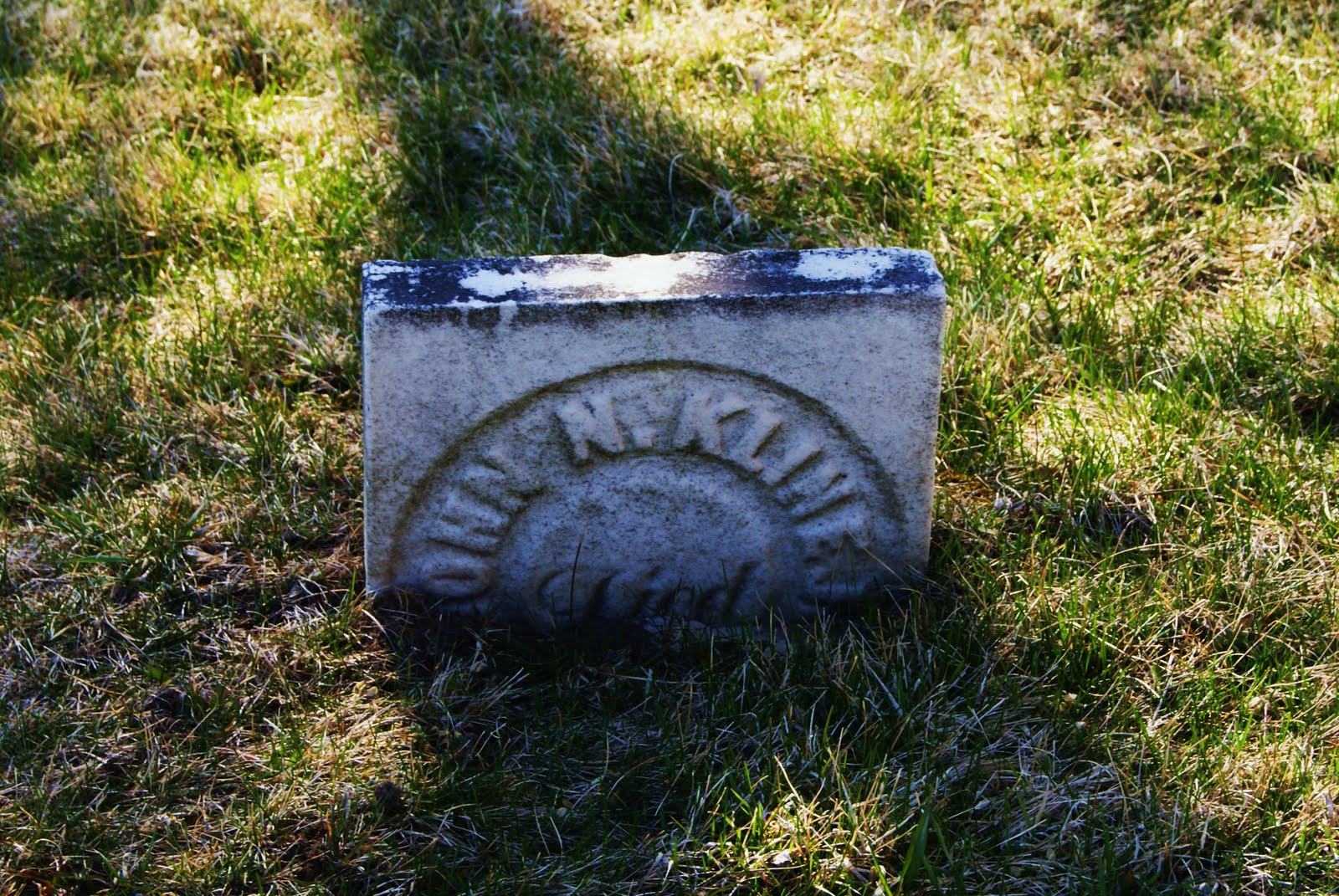
Grave of John Nicholas Kline

Gate Dedicated to the Society of Friends 1932 

Schomberg Union Cemetery, originally Friends Quaker Cemetery is located on the west side of Hwy 27 north of Lloydtown- Aurora Rd in Schomberg Village, Twp. of King.

The cemetery was established in 1833 by the Society of Friends (Quakers).  The chapel on the property was typical of the simple austere building used by the Quakers, referred to as a meeting house. The Quaker pioneer graves are located at the center of the  property, they are small white simple markers arranged in neat rows. The cemetery today is non-denominational and is managed by the Schomberg Cemetery Board.

Notable burial is that of John Nicholas Kline, d.1854 at 29 years of age.  The village of Kleinburg is named for him.  His house still stands at the N/E corner of Islington Ave and Nashville Rd in Kleinburg, City of Vaughan.


Saturday, April 23, 2011

St. Patrick's Roman Catholic Church & Cemetery (Wildfield) Brampton

St. Patrick's R.C. Church, Brampton


Cairn Containing Headstones from
the Original Settler Burials

The Wives of Barnard McMahon

Cairn with the names of 375 people


St. Patrick's R.C. Church and Cemetery is located on the S/E corner of The Gore and Mayfield Roads in Brampton. The area was originally called Grantville in 1833 after a scotch settler named Simon Peter Grant, then Gibbon in 1873 after Father John Joseph Gibbon and finally in 1891, Wildfield.  In 1834, 200 acres were deed to the trust of St. Patrick's Parish with the N/W corner being designated as a cemetery. The rest of   the property was used as a farm to educate orphaned boys The first registered burial occurred in 1833 that of Catherine Burns.  The present day church on the property was built by Father Francis McSpirit in 1894.

In 1964 the upright head stones were gathered into the cairn which is located at the front of the property and only in ground monuments are now used.  A cairn also contains a large bronze plaque containing the names of 375 settlers who were buried here.  The parish is still active, but the cemetery is only open to those who have family plots. This site is a designated heritage site by the Brampton Heritage Board.