Monday, November 7, 2011

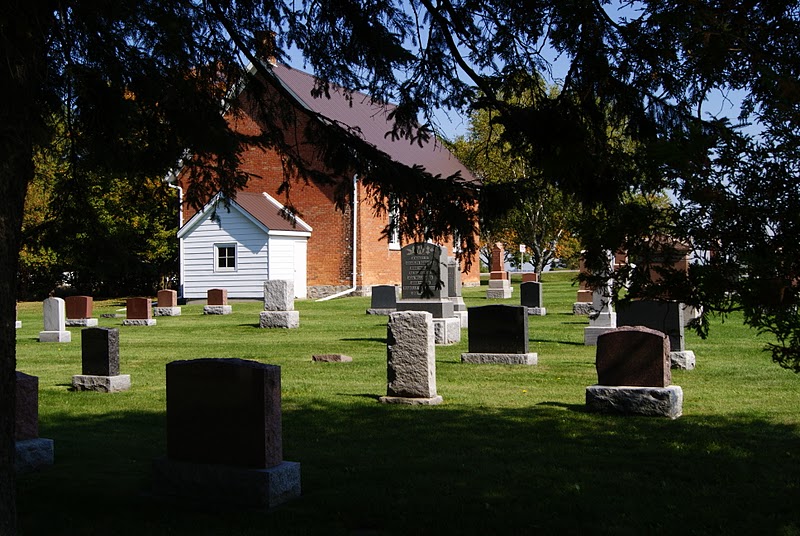
Boston Presbyterian Church & Cemetery, Halton Hills

Heritage Plaque


Church & Grounds


Grave of James Laidlaw 1820

Located at 9185 Third Line, Halton Hills, Boston Presbyterian Church and Cemetery was established in 1824 on land that was purchased from Andrew Laidlaw by the church trustees.  Prior to the first church and establishment of the cemetery the congregation met on the farm of Andrew Laidlaw from about 1820. As the above photo shows the Laidlaw family were already using the land for burials.  The area was and is still known as Scotch Block, due to the Scottish settlers that came either directly from Scotland or via the USA around 1819. 

In 1832 there was a large contingent who separated from this congregation, due to different views concerning articles of faith. This group would become the United Presbyterian Church, (Mansewood United Presbyterian), which is located a few kilometers down the road. This church was closed in 1931 and eventually removed from that site.

The present day church was build in 1868 and named after Thomas Boston, significants unknown,  the cemetery association was formed in 1911.  Boston Presbyterian Church is still an active parish and the cemetery is still used for burials. Both the church and cemetery are a designated heritage site.

Wednesday, November 2, 2011

Mansewood United Presbyterian Cemetery, Milton, Halton Hills

Cairn made from building stones from
the demolished church building

Heritage Dedication 

Rear of Cairn
The rectangle area at the back is the old foundations
Corner stones can still be found in the ground


Mansewood United Presbyterian Cemetery is located on the N/W corner of 3rd Line and 5th Side Road in Milton, Halton Hills.  The original church on this site was built in 1836 and was referred to as the Antiburger Church.  Burials in the cemetery also commenced around this time and continued in to the early 1900's.

The second stone church was built in 1866 and the manse was built in 1872.  The congregation continued until 1931, the church was then only used for anniversaries until 1951 when if fell into disuse.  The building was eventually removed in 1958 and some of the building stones were used in the cairn which is now on the site.  At the back of the cairn a another cairn containing 12-15 headstones, there is also four standing monuments on the grounds.  

If you stand facing due east you will see the foundation lines for the stone church.  Some of the corner stones from these foundations can still be seen in the ground.  This site today is designated as a Heritage Site and is maintained by the Town of Milton.

Campbellville Buryng Ground, Campbellville, Halton Hills

Heritage Cairn

Campbell Family Graves

Grave of John Campbell
Who died after being struck by lightening

Grave of 8 year old Lexy Campbell
Earliest Burial

Early Burials


Campbellville Burying Ground is located in Campbellville, Halton Hills on the north side of McLaren Road, just west of Main Street (Guelph Line) Milton. The land was donated by John Campbell and his wife Lexy (Alexine Buchanan) in 1853.  The Campbell's immigrated from Argylshire Scotland in 1831, after spending one year in Montreal the family made its way to Halton in 1832 and purchased 100 acres of land.  

Although, the official opening date of the cemetery was in 1853, it is evident that burials had taken place at earlier dates.  The first burial was that of Lexy Campbell, John and Lexy Campbell's 8 year old daughter who died in 1840.  There is also evidence of other members of the Campbell family buried here before 1853.

On April 25th, 1854 just one day after John Campbell had placed his mark on the receipt for the sale of the land he was killed by a lightening strike while working in his barn.  John is buried in this cemetery beside family and friends on the land he once owned since 1832, in the town that still bears his name.

Christ Church Anglican Cemetery, Woodbridge


Early Head Stones

Wooden Grave Marker
Name long gone

Christ Church Anglican Cemetery is located at 8045 Islington Ave., in the Woodbridge area of the City of Vaughan.  The church and cemetery was established in 1850 on land donated by William Gamble, although there appears to be burials prior to that date. 

The stone church building was built by William Tyruel who was also responsible for building the Old Mill on Bloor Street.  Many notable families from the Village of Woodbridge are buried here such as, Wallace, Gamble, and Abel.  Their descendants still live in the area. 

William Gamble is buried at another Christ Church location on Royal York Rd, where he also donated the land.  The cemetery and church are still both active.

Thursday, September 29, 2011

Peach's United Church Cemetery, Markham

Peach's United Church est 1847.


Pioneer Headstones


Peach Family Monument

Peach's Primitive Methodist Church  Cemetery, aka Peach's United Church Cemetery is located at the N/W corner of McCowan Rd and Elgin Mills Rd., E. in the town of Markham.  Although, the church and cemetery were established in 1847 the land was not donated to the Primitive Methodist Church until 1863 by Thomas Peach.  Prior to that year the congregation met at the school house which was located on the S/E corner. It was closed and renovated then moved to the N/W corner. 

A stipulation was made by Thomas Peach with the donation of land for the cemetery, and that was all plots were to be free.  The cemetery was enlarged 1891, both Thomas and his wife Catherine are buried here.

The cemetery still received burial for those with family plots and is managed by the United Church of Canada.


Thursday, September 15, 2011

Fisherville Presbyterian Church Cemetery, Thornhill

Heritage Cairn sits on the site of the Fisherville Church


Remnants of  Old Monuments found behind the Cairn


Earliest Marker found in Cemetery


Fisherville Presbyterian Church Cemetery, aka Fisherville United Church Cemetery is located up a steep embankment on the north side of Steeles Ave, just east of Dufferin Street in the Thornhill area of the City of Vaughan.  

Fisherville was founded by Jacob Fisher who in 1797 migrated with 22 members of his family from Pennsylvania to this area. He received a track of land that was located on the north side of what is now Steeles Ave and east of Dufferin Street were he established a sawmill.  His daughter Elizabeth Fisher, would later marry Daniel Stong who's farm was located at the south east corner of Jane Street and Steeles Ave, what is now the grounds of York University and Black Creek Pioneer Village. The houses and barns of the Stong Farm are now preserved and part of Black Creek Pioneer Village.
  
The church and cemetery were established around 1836, the earliest marker is 1840 for Isabel Watson.  The cemetery was closed to burials in 1905 and the church building was moved to Black Creek Pioneer Village in 1960.  The site was restored by the Twp of Vaughan in 1967, today it is maintained by the City of Vaughan.

Brown's Wesleyan Methodist Cemetery, Caledon


A few remaining monuments from the original cemetery

Remnants of  plot markers found in bushes

Brown Family Monument
Brown's Wesleyan Methodist Cemetery is located at the north end of the Caledon East Public Cemetery in Caledon East on the west side of Airport Road just south of Hwy 9. The land was originally donated by James Brown and his wife Mary Kyle Brown  around 1850 for a church and cemetery.

The church was moved from its original location on this lot in 1915 to the side then sold in 1938 for $ 64.00 and dismantled and removed in 1942.  The earliest marker is for 1850 and the last for the Wesleyan Methodist parish is for 1964.

A cairn with early headstones from the original cemetery is located at the north east corner of the original cemetery site.  Today the site is maintained by the Town of Caledon.